Wolf Oven Repair
Wolf Oven Door Locked After Self-Clean: A Newton Walkthrough
A Wolf door still locked after self-clean is usually a latch waiting on the control's permission rather than a broken part. This Newton walkthrough explains the mechanism, separates a cool-down wait from a power failure, and says exactly where to stop.
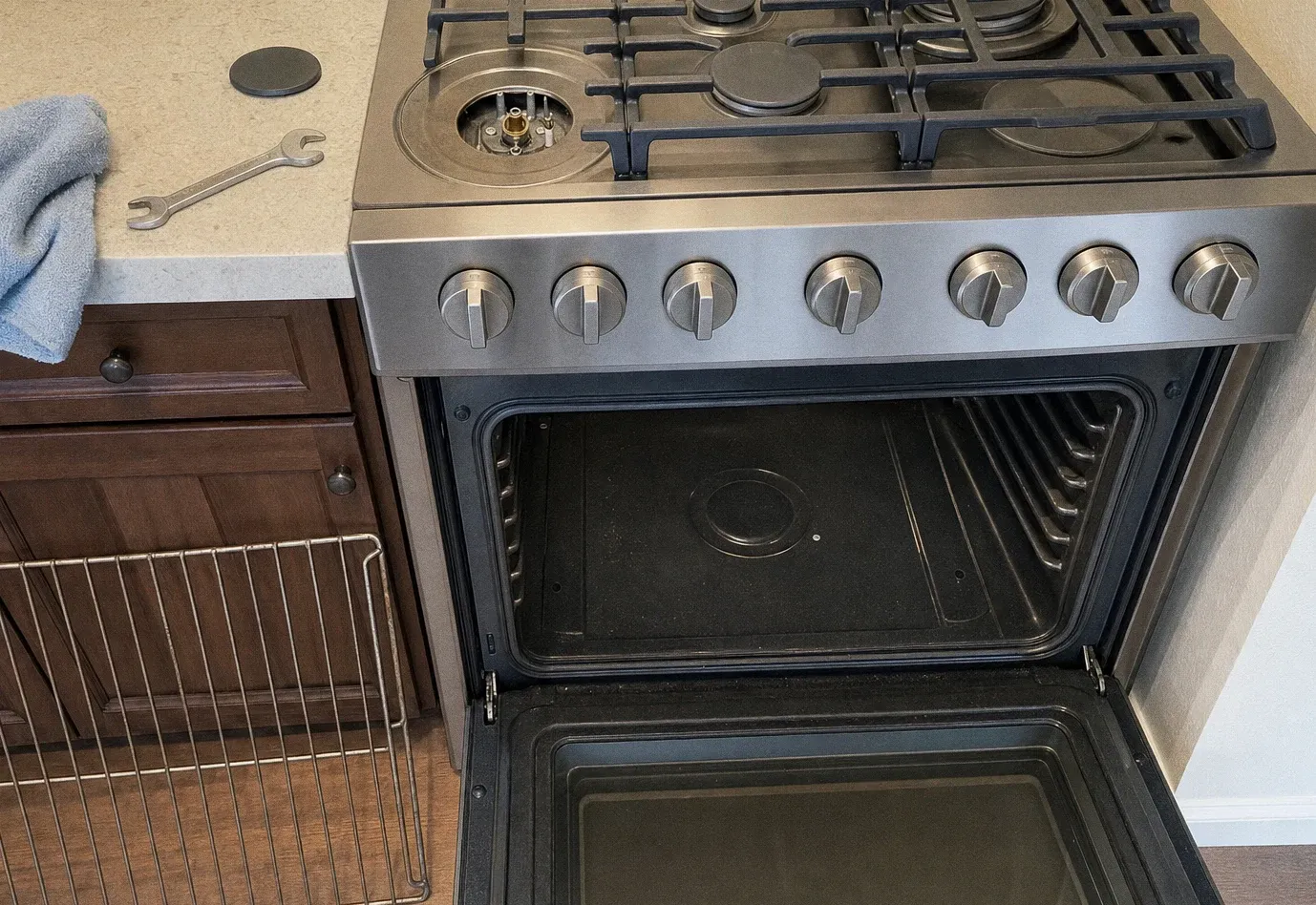
The reason a door that will not open after a clean cycle feels like a mystery is that most people have never been told what the lock actually is. It is not a bolt the appliance throws for the fun of it, and it is not electronic in any mysterious sense. It is a motor, a switch that reports position, and a control that will not act until those two tell the same story. Once that is clear, the whole fault becomes readable.
First: how long is it supposed to stay locked?
Assume the wait is normal until the appliance is cold. Release is granted on a temperature condition, not a countdown, and the clean phase leaves the interior far hotter than any recipe ever asks for — so the door stays held long after the display has finished counting and the kitchen has stopped smelling of the cycle.
There are three things to look at while it happens. Is a lock indicator showing on the panel? Is a cooling fan still audible with the appliance apparently idle? Is the trim above the door still giving off heat? All three saying yes means the sequence is running, not stalling.
Patience runs out at a specific point rather than a vague one. All three of these have to be true together: the interior has come back to room temperature, the appliance has made no sound for hours, and the door is still shut fast. Until then, waiting is the diagnosis.
Newton makes that wait land harder in some houses than others. The mill conversions above the Charles in Newton Upper Falls have galley kitchens with a single cavity and no room for a spare anything. In West Newton, where the kitchen has usually been opened into a family room at the back, the whole floor lives with the smell of a clean cycle for the evening, which is why people run it late and discover the problem at breakfast.
Check whether the oven still has power at all
Two very different faults look identical from across the kitchen: a latch refusing to release, and an appliance that has quietly lost supply. Separate them by looking at the panel rather than the door. Anything lit — a clock, a lock symbol, a code — means the control is alive and holding. Nothing lit, and no response to a touch, means power is the first question.
Go to the breaker. A single deliberate power cycle, off for a full minute and back on, is a reasonable test: it tells you whether the control can restart and re-examine the latch. Treat the result as information. If the panel returns and the door releases, the control had lost its place. If it stays dark, nothing is arriving at the board at all.
A blown thermal fuse is the commonest explanation for that. It is a one-shot safety component fitted where excess heat needs intercepting, and it opens permanently — there is no reset, only replacement. Finding one open is finding a part that worked correctly, and the real question is what conditions pushed it that far.
That is precisely why going back to the breaker again and again is not a plan. A circuit that has already interrupted itself once is not asking to be re-energised repeatedly; each attempt is a search for the next thing to fail.
The mechanism behind the door
Picture three things. A small motor. A bolt or cam the motor drives across the door frame. A switch positioned so that it changes state only when that bolt has arrived where it should be. The control commands the motor, then waits to be told the move happened, and it will not release the door — or permit heating — until it hears back.
That single design decision explains nearly every version of this fault. A latch that never moved leaves you with silence and no change. A latch that moved and was not believed gives you a brief mechanical sound followed by exactly the same locked door, because the control has no confirmation to act on and will not assume one.
Then there is the physical version. Everything in that assembly expands and contracts across a cycle that hot, and it does not always return to precisely where it began. Add residue baked hard into the track and the bolt can bind a fraction short of home — close enough to look right, far enough that the switch never changes state.
None of this is accessible with the appliance assembled, and it sits among mains-voltage wiring in a compartment that has just been extremely hot. This is where a homeowner stops; our Wolf Oven Repair page describes what the work looks like from there.
Once the door opens, check these
The cycle finds anything marginal, so the release is not necessarily the end of it. Elements with a fault too small to matter at normal cooking temperatures often give up at clean temperature. Relays that switched reliably for years can stick on the cycle that finally asks too much of them. Seals harden and stop compressing, which shows up later as heat escaping across the top of the door.
That is why an appliance can open perfectly well and then bake badly. Preheating that takes far longer than it used to, a cavity that drifts cooler through a long roast, or heavy browning on one side are all worth reporting as part of the same event rather than as a new complaint a fortnight later.
Ash is normal. Expect a fine grey powder across the floor of the cavity and a light haze on the glass, both of which wipe away once the appliance is cool. Treat scorch marks, darkened metal beside an element, or a smell of hot insulation that outlasts the smell of the cycle as findings instead.
The manual alternative
An honest position: the clean cycle works, and it is also the most demanding thing the appliance ever does to itself. It is not a reason to avoid the feature, but it is a reason to think about when you use it. Running it the day before an occasion that depends on the kitchen puts the appliance’s hardest test immediately before its most important job.
The better habit is to run it when nothing depends on the outcome — a quiet weekend, with the house ventilated and nobody waiting on the cavity. If something marginal is going to reveal itself, it reveals itself at a moment when a repair can be booked calmly.
Manual cleaning remains a genuine alternative rather than a consolation prize. A cool cavity, a suitable cleaner left to soften the residue, and some patience will handle ordinary soiling without taking the appliance anywhere near its thermal limits. Plenty of Oak Hill and Auburndale households alternate: manual most of the time, the full cycle occasionally.
When to stop and call
Three symptoms end the do-it-yourself stage outright. A burning-electrical smell. A breaker that trips again after being reset. A door still locked when the appliance has been completely cold for hours.
A visit answers what looking cannot. Whether the protective fuse has opened. Whether an unlock instruction actually reaches the motor, and whether the motor obeys it. What the board is holding in memory, which is invariably more than the panel chooses to show. Those three findings separate a fuse from a latch from a control.
Do not force the door. That bolt is sized to keep a heavy, hot door shut, and it will beat a lever right up to the moment something deforms — at which point one replaceable part has become a wrecked latch, a twisted door and a considerably bigger job.
The service call is $95. Published bands cover $140 to $720 for thermostat or sensor calibration, $500 to $1,590 for a control board or touch panel, and $210 to $930 for door hinge, glass or seal work, and which one applies is decided by the diagnosis rather than by the symptom. We cover Oak Hill, West Newton and Auburndale — reach us on the number at the head of the page, or use the booking link.
Also asked
The oven opened but now will not heat — are the two related?
They usually belong to the same event. Clean temperatures run well above anything cooking asks for, and a heating element or relay that was already marginal often fails under that load rather than during a normal bake. So the door releasing and the cavity then running cold are two readings of one afternoon. Describe both when you call; it shortens the diagnosis considerably.
The display shows a code — does that tell me which part failed?
It tells you what the control saw, not what broke. Codes describe observations — a reading outside the possible range, a latch that never reported itself home — and several distinct faults can produce the same observation. Photograph the panel before you cut power, since a reset deletes the code permanently and it is the single most useful thing you can hand a technician.
Can I force the door open?
No, and the reason is mechanical rather than cautious. The lock is built to hold a heavy door closed against thermal load, so it will resist a lever until something gives — and what gives is usually the latch assembly, the door frame or the glass. Forcing turns one replaceable component into three, and it does nothing about whatever stopped the release in the first place.